
Key Takeaways
- The 4-2-2-2 formation features four defenders, two holding midfielders, two attacking midfielders, and two strikers.
-
- People often call it the magic rectangle because the two pivots, two attacking midfielders, and two strikers form a narrow box in the center.
-
- This formation works well for quick passing in the center, pressing, counterpressing, and fast attacks through the middle.
-
- Its main weakness is that it lacks natural width, so full-backs need to support attacks on the wings.
-
- Opponents often try to beat this system by moving the ball quickly, attacking wide areas, and creating two-against-one situations against the full-backs.
-
- This system only works if players understand spacing, timing, recovery runs, and when to press.
Table of Contents
Everything About The 4-2-2-2 Formation
The 4-2-2-2 formation in football uses four defenders, two central midfielders who play deeper, two attacking midfielders, and two centre-forwards. In 11-a-side football, each team has eleven players, including a goalkeeper, but formation numbers usually refer only to the ten outfield players.
This is how the formation is usually set up:
| Line | Players | Main Responsibility |
|---|---|---|
| Defence | 4 | Protect the back line, build play and support width through full-backs |
| Holding midfield | 2 | Protect central spaces, connect defence to attack and cover transitions |
| Attacking midfield | 2 | Receive between the lines, combine with strikers and create chances |
| Attack | 2 | Occupy centre-backs, link play, press and finish attacks |
The 4-2-2-2 formation is often called the magic rectangle, magic box, or magic square. These names come from the tight central shape formed by the midfielders and attackers.
That’s why this formation is more than just a lineup. Teams use it for attacking, defending, and managing transitions during a match.
What Is The 4-2-2-2 Formation And How Does It Impact The Game?
The 4-2-2-2 formation brings players close together in the middle of the field. This setup lets teams combine quickly, press right after losing the ball, and attack using short passes.
When the team has the ball, this system often forms a strong central lane. The two midfielders stay behind the ball to support, the attacking midfielders find space between defenders, and the strikers keep the opponent’s centre-backs occupied.
This approach can make play faster since the ball does not always have to go wide before moving forward. A midfielder can pass to a number 10, who can quickly play it to a striker, and the striker can set it up for a teammate making a run.
When the team does not have the ball, the formation becomes compact. The strikers begin the press, the attacking midfielders block passes into the middle, and the two midfielders protect the area in front of the centre-backs.
The key factor is the type of players used. If the team has aggressive forwards and hard-working attacking midfielders, the system can focus on pressing. If the midfielders are technical and the strikers are calm, it can be more about keeping possession and combining passes.
WANT TO UNDERSTAND TACTICS WHILE TRAINING IN SPAIN?
A formation only helps you when you understand your role inside it. At Alicante Football Academy, we train players to read spaces, press with timing, and adapt to different systems in real football situations.
Apply for Alicante Football Academy
What Are The Key Components And Implementations Of The 4-2-2-2?
The 4-2-2-2 formation includes a back four, a double pivot, two attacking midfielders, and two strikers. Each group has its own role, but the system depends on keeping the right distances between them.
Centre-backs need to defend large spaces since full-backs often move forward. They should also look to pass into midfield, not just play safe sideways balls.
Full-backs play a key role because this formation does not use natural wingers. They provide width in attack, receive switches, and deliver crosses. FIFA’s analysis of FC Salzburg’s 4-2-2-2 shows how their full-backs pushed up the wings to give the team width and act as attacking outlets.
The double pivot helps protect the center of the field. Sometimes one stays back while the other joins the attack, but both need to cover if the full-backs push forward.
The two attacking midfielders operate in the half-spaces and between the lines, not as traditional wingers. They should receive the ball on the turn, combine quickly, press after losing possession, and only move wide when the attack needs extra support.
The two strikers need to keep the centre-backs busy, work together, and attack the penalty area. When pressing, they help steer the opponent into areas where their team can win the ball back.
Why Is 4-2-2-2 Called The Magic Rectangle?
The 4-2-2-2 formation is known as the magic rectangle because the two holding midfielders, two attacking midfielders, and two strikers form a narrow, box-shaped area in the center of the field.
This rectangle gives the team plenty of short passing options. The holding midfielders can pass forward to the attacking midfielders. The attacking midfielders can link up with the strikers. The strikers can drop back and set up the ball for teammates making runs.
The magic isn’t just in the name. It comes from the support angles. When players keep the right distances, the one with the ball almost always has a forward pass, a bounce pass, and a third-man option.
In training, we tell players not to just stand in the box, but to make it useful. If a passing lane is blocked, move a few meters. If your teammate is under pressure, be ready to offer a bounce pass. If the striker drops back, someone else should run forward.
What Are The Key Tactical Principles Behind The Formation?
The 4-2-2-2 formation relies on several key tactics: central overloads, vertical compactness, half-space occupation, pressing support, and quick transitions.
Central overload happens when your team has more players than the opponent in a key central area. This makes it easier to move through midfield, especially if the other team only has two central midfielders.
Vertical compactness is when the team’s lines stay close together from front to back. If the strikers get too far from the midfielders, the team can become stretched and easier for opponents to break through.
Half-space occupation is important too. The two attacking midfielders are most effective when they play between the center and the wings. From these spots, they can cut inside, link up with the strikers, or pass to the full-back on the outside.
Timing is more important than where a player starts. Even if someone stands in the right spot, he won’t help the team if he moves too soon, faces the wrong way when receiving the ball, or gets in the way of a teammate’s pass.
Which part of the 4-2-2-2 challenges you most right now?
What do you need to improve first inside the 4-2-2-2?
Solution:
Focus on the magic rectangle. Work on receiving behind midfield, playing one-touch bounce passes, and connecting the double pivot, attacking midfielders, and two strikers with quick central combinations.
Solution:
Focus on full-back timing. The 4-2-2-2 can become too narrow, so your priority should be learning when the full-back overlaps, when the attacking midfielder supports wide, and when the pivot covers the space behind.
What do you need to improve first inside the 4-2-2-2?
Solution:
Focus on pressing triggers and counterpressing. Train the two strikers to lead the press, the attacking midfielders to block central passes, and the double pivot to stay balanced behind the ball.
Solution:
Focus on defensive balance. The main risk in the 4-2-2-2 is space on the wings, so train recovery runs, full-back discipline, pivot cover, and fast reactions when the opponent switches play.
How Does The 4-2-2-2 Defend And Press?
The 4-2-2-2 formation defends by keeping the team compact in the middle, making it harder for opponents to find space. Teams can use this shape to press high, hold a mid-block, or fall back into a more defensive 4-4-2.
When pressing high up the field, the two strikers lead the pressure. One striker goes after the centre-back with the ball, while the other tries to block passes across or keep the defensive midfielder from receiving the ball.
Just behind the strikers, the two attacking midfielders start out close together. If the ball moves wide, they can press the full-backs, or they can stay central to block passes into the middle.
The two holding midfielders need to anticipate where the next pass will go. If one steps forward too soon and the other does not cover, the opponent can break through the middle. According to FIFA’s coaching material on counterpressing, teams need defensive balance when pressing high and must react quickly and in an organized way if they lose the ball.
The main risk is leaving too much space on the wings. If the team presses too narrowly and the opponent moves the ball quickly across the field, the full-back on the far side can end up alone and exposed.
How Does The Team Transition To Defence From This Shape?
When a team loses possession in a 4-2-2-2, the nearest players should press right away. The goal isn’t always to win the ball back instantly. Sometimes, it’s better to slow the opponent so the rest of the team can regroup.
The double pivot plays an important role. If both midfielders move ahead of the ball, the center-backs are left unprotected. If both stay too far back, the team can’t counterpress well. Strong teams manage to find the right balance.
Full-backs need to stay disciplined. Since they give the team width in attack, they have to judge when to push forward and when to stay back. If both attack at once without cover, the team risks getting exposed on the flanks.
FIFA’s analysis of FC Salzburg is a good example. Their narrow 4-2-2-2 shape kept many players near the ball, which helped them counterpress quickly after losing possession.
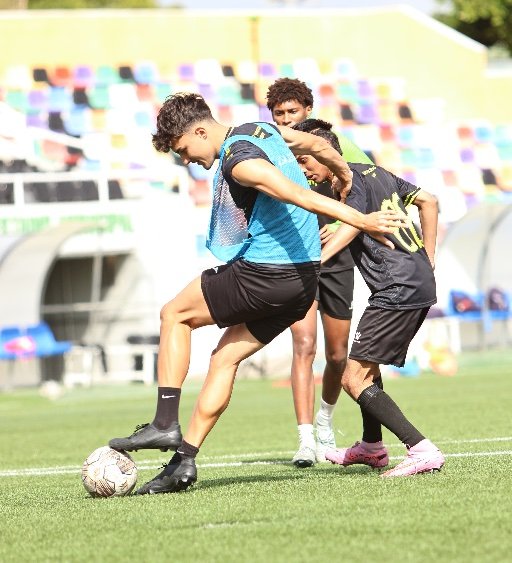
What Are The Typical Attacking Patterns In A 4-2-2-2?
In a 4-2-2-2 formation, teams often attack using central combinations, third-man runs, striker link play, full-back overlaps, and quick switches after pulling the opponent inside.
Here’s an example of a simple attacking pattern:
- The center-back passes to the pivot.
- The pivot then plays the ball forward to the attacking midfielder.
- The attacking midfielder quickly passes the ball to a striker.
- The striker lays the ball off for the other attacking midfielder or a pivot making a forward run.
- Next, the ball goes wide to the full-back or is played through to the second striker.
This makes the formation dangerous because it draws defenders into the middle, then quickly moves the ball outside or behind them.
How Does The 4-2-2-2 Handle Transitions And Counterattacks?
The 4-2-2-2 formation is effective during attacking transitions since players are already positioned close together in central advanced areas.
When the team wins the ball in midfield, they can often make a quick forward pass to an attacking midfielder or striker. This lets them attack with four players before the opponent has time to reorganize.
This is why teams that press prefer this formation. Winning the ball high up the field means you need only a few passes to create a chance, since two strikers and two attacking midfielders are already close to goal.
However, there is also a risk. If the first press fails, the opponent can attack the wide spaces behind the full-backs. UEFA’s analysis of Leipzig vs Shakhtar showed how Shakhtar invited Leipzig to press and then used the wide areas to take advantage of Leipzig’s narrow midfield.
What Should Training Focus On When Implementing A 4-2-2-2?
When training a 4-2-2-2 formation, focus on central combinations, pressing triggers, keeping compact distances, timing for full-backs, recovery runs, and quick reactions during transitions.
At Alicante Football Academy, we want players to do more than just memorise a formation. We encourage them to understand the reasons behind their movements. When players grasp the idea, they can adapt if the coach changes the system.
A good training session might begin with unopposed pattern play, but it should progress beyond that. Players need to experience pressure, face defenders, use limited touches, and practice realistic transition moments.
Training sessions should cover the following areas:
- Central passing patterns involving pivots, attacking midfielders, and strikers.
- Pressing triggers, like a poor touch, a backwards pass, or a pass to the full-back.
- Counterpressing actions right after losing possession.
- Full-back timing, especially knowing when to overlap and when to hold position.
- Defensive recovery, making sure the team stays compact and does not get stretched.
- Scanning and body positioning, since receiving the ball between the lines can be challenging.
A scientific review on tactical formations and soccer performance found that formations can influence both physical and technical match performance. Coaches can use this information to help players prepare for specific roles on the field.
Here is a quick self-check for players:
If you play as an attacking midfielder in a 4-2-2-2, ask yourself these questions:
- Can I receive the ball between the lines without hiding behind a defender?
- Can I play one-touch combinations even when under pressure?
- Do I press right away after losing the ball?
- Can I move wide to support the full-back without turning into a winger for the whole game?
- Do I know when the striker wants the ball played to their feet or into space?
If you answered no to most of these questions, playing in this system might feel challenging. If you answered yes, this formation could be a great fit for you.
READY TO TEST YOUR GAME IN A REAL ACADEMY ENVIRONMENT?
Learning tactics on a screen is useful, but the real test comes when you have to scan, move, press, and make decisions under pressure. Our soccer camp in Spain gives players daily training and a clear view of academy football.
Join our soccer camp in Spain
What Are The Benefits Of A 4-2-2-2 Formation?
The main advantage of the 4-2-2-2 formation is that it gives the team more players in the center of the field.
This setup can help with several things:
| Benefit | Why It Matters |
|---|---|
| Central overloads | Helps the team progress through midfield |
| Two strikers | Occupies both centre-backs and gives more box presence |
| Double pivot | Protects the defence and supports build-up |
| Strong counterpress | Players are close together when the ball is lost |
| Fast combinations | Short distances make one-touch play easier |
| Transition threat | The team can attack quickly after winning the ball |
Coaches’ Voice explains that the 4-2-2-2 formation can create central overloads against opposing central midfielders. It also helps with counterpressing since players stay close to the ball when possession is lost.
Another benefit is that it gives players clear roles and connections. The pivot knows where the attacking midfielder is, the attacking midfielder knows where the striker is, and the full-back can see when inside players pull opponents closer together.
With good timing, the team can attack quickly while keeping its shape.
What Are The Weaknesses Of The 4-2-2-2 Formation?
The main weakness of the 4-2-2-2 formation is its lack of natural width. Because the attacking midfielders stay central, only the full-backs usually provide width on the field.
This can cause problems. If the full-backs stay back, the team’s attack becomes too narrow. But if they push forward, the team can be left open to counterattacks.
Another issue is that central players might get in each other’s way. If both attacking midfielders and both strikers line up in the same area, it becomes easier for the opponent to defend with fewer players.
The 4-2-2-2 can also struggle against teams that move the ball quickly from side to side. Because the wide areas are often left open, it is vulnerable to accurate switches of play.
For player development, this system requires strong tactical awareness. Speed and technical skill are not enough. Players need to know when to press, drop back, cover, and rotate.
NOT SURE WHICH FORMATION FITS YOUR POSITION?
Some players look strong in one system and lost in another. Our formation guide explains how different shapes change your responsibilities, from midfield support to pressing and wide defending.
Learn more about soccer formations
What Is The Counter To The 4-2-2-2 Formation?
There isn’t one perfect way to counter the 4-2-2-2 formation. However, the most common approach is to make the field wider and focus attacks on the flanks.
Teams can try to beat the 4-2-2-2 by using these tactics:
- Move the ball quickly from one side of the field to the other.
- Create two-against-one situations against the full-backs.
- Use wide wingers to keep the full-backs close to their own goal.
- Play around the central press rather than trying to go through it.
- Pull the two central midfielders forward, then attack the space they leave behind.
- Make the attacking midfielders defend out wide for long stretches.
The goal is to force the 4-2-2-2 to defend areas it usually avoids. When the two attacking midfielders are pulled out to the sidelines, the team loses its usual shape in the middle.
Which Teams And Coaches Have Used The 4-2-2-2 Successfully?
Many coaches have found success with the 4-2-2-2, but they often use it differently.
Manuel Pellegrini has used the 4-2-2-2 with teams like Real Madrid, Villarreal, Manchester City, and Real Betis. According to Coaches’ Voice, his teams often attacked wide with their full-backs while central players worked together inside.
Ralph Hasenhüttl used this formation with aggressive pressing at RB Leipzig and Southampton. His teams aimed to win the ball and attack quickly through the middle.
Ralf Rangnick is also known for using the 4-2-2-2, focusing on pressing and quick transitions. In his approach, the system is less about slow possession and more about forcing mistakes, winning second balls, and attacking fast.
RB Leipzig have used the 4-2-2-2 in Champions League games as well. UEFA’s analysis of their match against Manchester City described Leipzig playing in this shape and trying to move the ball through the middle.
FC Salzburg is another good modern example. FIFA’s 2025 analysis described Salzburg’s build-up as a back four, two central midfielders, two number 10s, and two number 9s. The full-backs provided width, while the central players helped keep up the counterpress.
The main point is that the same formation can look very different depending on the coach. One might use it for high pressing, another for controlling the center, and another for quick counterattacks.
That’s why we always remind players to focus on the principles behind the formation, not just the numbers.
WANT TO COMPARE THE 4-2-2-2 WITH ANOTHER DOUBLE-PIVOT SYSTEM?
The 4-2-2-2 and 4-2-3-1 both use two deeper midfielders, but they create very different attacking and defensive pictures. Compare both systems to understand how small changes in shape affect the whole team.
Read our 4-2-3-1 formation guide